return to the MAIN pageGo BACK PRINT this page
The Official Website of Andrew Vachss
 

Dispatches from the Front Lines
Articles and Essays written by Andrew Vachss

Speeches by Andrew Vachss


A Long Time Coming: Closing New York's Incest Loophole
(exclusive to PROTECT.org, July 27, 2006)
PROTECT's 2006 legislative victory in New York state began with a very influential Op-Ed article in The New York Times, on Nov. 11, 2005, by Andrew Vachss. So PROTECT asked Mr. Vachss to write an article about the final passage of this landmark reform. To read Mr. Vachss' thoughts and reactions on this victory and what it means for children, click here! [note: link opens in new window]

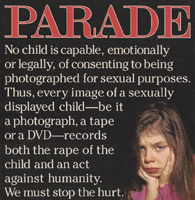
Let's Fight This Terrible Crime Against Our Children
(Parade Magazine, February 19, 2006)
"No child is capable, emotionally or legally, of consenting to being photographed for sexual purposes. Thus, every image of a sexually displayed child—be it a photograph, a tape or a DVD—records both the rape of the child and an act against humanity."

  • In his powerful article, Vachss wastes no time on the usual sentimentality or rhetoric that surrounds the topic of child abuse. He has declared war and asks Americans to join him. In this exclusive interview, Vachss talks with PROTECT about his PARADE article, the role of PROTECT in making change and exactly how Americans can wage, and start winning, the war on child pornography. [note: link opens in new window]

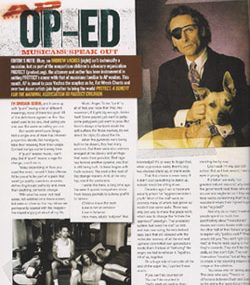
AP Op-Ed: Musicians Speak Out
(AP International, December 2005)
"If 'punk' means music, I can't play. But if 'punk' means a rage for change, count me in."

The Incest Loophole
(The New York Times Op-Ed, November 11, 2005)
"Most citizens agree that child molesting is one of the foulest crimes imaginable. Yet New York's law—much like that of most other states—allows the possibility of privileged treatment for a special class of offender: the perpetrator who is related to his prey. In other words, the penal code gives a discount to child rapists who grow their own victims."

Unsafe At Any Age
(The New York Times Op-Ed, June 15, 2005)
"A trial is not a search for truth. It is a contest, and often, one that produces no winners. In certain cases—the Scottsboro Boys and Roy Bryant and J. W. Milam in the murder of Emmett Till—a trial produces an outcome so repulsive that we are shocked into individual and collective self-examination. Other trials cost us much, but teach us nothing. Guess where the Michael Jackson verdict fits in?"

Watch Your Language
(Parade Magazine, June 5, 2005)
The media calls the sexual assault of a child "fondling," and they term incest a "nonviolent crime." So what harm does that do? Read "Watch Your Language" by Andrew Vachss to find out.

What Are You Going To Do About Child Abuse?
(Parade Magazine, August 22, 2004)
"This election year, we must demand that politicians pledge to protect our children. It's time to ask our Presidential candidates … What Are You Going To Do About Child Abuse?"

A Promise Kept
(CWRU Magazine, Fall 2002, Vol. 15, No. 1)
A good education is a terrible thing to waste—a great education refuses to be wasted. Read Andrew Vachss' tribute to his alma mater, Case Western University, as published in CWRU Magazine.

The Difference Between "Sick" and "Evil"
(Parade Magazine, July 14, 2002)
"The difference between sick and evil cannot be dismissed with facile eye-of-the-beholder rhetoric. There are specific criteria we can employ to give us the answers in every case, every time."

If We Really Want To Keep Our Children Safe
(Parade Magazine, May 2, 1999)
"To truly protect children from sexual predators on the Internet as well as off we must consider crucial changes in our thinking, our laws and our tactics."

United States National Commission on Libraries and Information Science
"The greatest danger of the Internet to vulnerable children is not the display of kiddie porn ... it is the very real potential for enticement."
Andrew Vachss' testimony before the United States National Commission on Libraries and Information Science, presented on Tuesday, November 10, 1998.

Broadside
(Pulse! magazine, October, 1998)
"Words may evoke feelings. They don't, in and of themselves, cause conduct."

CHECK IT OUT!
People v. Behrooz Kanani, Ind. No. 4192/90
Andrew Vachss' recent Parade article has already had a concrete, quantifiable result—it helped put a predator down for hard time.

Behrooz Kanani was convicted of Sodomy 1. His sentencing took place shortly after the publication of Andrew Vachss' Our Endangered Species article. In the sentencing Judge Antonio Brandveen cited Vachss' article, and then sentenced Kanani to 100 - 300 years in state prison. Amy Belger, the Assistant District Attorney on the case, credits the article as making "an impact that helped my position at sentencing."

Our Endangered Species
(Parade Magazine, March 1998)
"Our notion of the human "family" as the safeguard of our species has not evolved. Instead, it has gone in the opposite direction—it has devolved."

'Cyber-chumps' Are Net's Big Victims
(MSNBC, January 1997)
"The real danger of the Internet is seduction of the arrogantly ignorant."

If We Really Want to Protect Children
(Parade Magazine, November 1996)
"There are far more people who love and respect children than there are those who prey upon them. But if that is so, why aren't we winning this battle?"

How Journalism Abuses Children
(The Zero, August 1996)
"Certain pernicious myths—not, it should be noted, 'cliches,' which often contain at least a core of truth—have so permeated journalism that they have become, in the minds of many Americans, 'facts.'"

The Ultimate Fascism
(EXPO, 1996)
"The ultimate fascism is child abuse. Its victims are Prisoners of War without a Geneva Convention to protect them, hostages to terrorism."

You Carry the Cure In Your Own Heart
(Parade Magazine, August 28, 1994)
"Emotional abuse of children can lead, in adulthood, to addiction, rage, a severely damaged sense of self and an inability to truly bond with others. But—if it happened to you—there is a way out."

How Many Dead Children Are Needed to End the Rhetoric?
(New York Daily News, August 12, 1994)
"We can no longer tolerate empty rhetoric—the stakes are too high. Child protection is crime prevention. We cannot have one without the other."

Age of Innocence
(The Observer, April 16, 1994)
"In truth, when it comes to child pornography, any discussion of censorship is a sham, typical of the sleight-of-hand used by organized paedophiles as part of their ongoing attempt to raise their sexual predations to the level of civil rights."

How to Handle Sexual Predators
(The World & I, August 1993)
"There are individuals who are so toxic that their presence threatens us all. They self-identify by their conduct."

Sex Predators Can't Be Saved
(New York Times, January 5, 1993)
"When it comes to the sexual sadist, psychiatric diagnoses won't protect us. Appeasement endangers us. Rehabilitation is a joke."

Pragmatically Impotent
(ABA Journal, July 1992)
"As a criminal justice response to the chronic, dangerous sexual psychopath, castration of any kind is morally pernicious and pragmatically impotent."

Comment on the Universality of Incest
(The Journal of Psychohistory, 1991)
"Incest is not 'sexual dysfunction'—it is violent abuse of power, arising from a complex series of motivations."

If You Could Listen to a Child's Soul
(Parade Magazine, January 16, 1991)
"What children are, more than anything else, is this: another chance for our flawed species to get it right."

Today's Victim Could Be Tomorrow's Predator
(Parade Magazine, June 3, 1990)
"If we really want to fight crime, we must start at its root—the abused or neglected child."

The Child Abuse Backlash: A Time of Testing
(Justice for Children, Vol. 2, No.3, 1989)
"Child abuse, once largely ignored by the general public, has been the subject of more media attention than perhaps any other issue in recent American history."

How We Can Fight Child Abuse
(Parade Magazine, Aug. 20, 1989)
"[T]he only pedophiles I have ever heard express remorse for their acts are those facing a sentencing court or a parole board."

Paying For Our Inaction
(New York Newsday, April 28, 1989)
"Today's victim of child abuse is tomorrow's predator. Any 'war on crime' that fails to recognize child protective services as the front lines exalts rhetoric over reality."

Are You Going To Hurt Me Too?
(Parade Magazine, October 13, 1985)
"The child who asks, 'Are you going to hurt me too?' is really speaking to all of us—to society at large. And if we face the hard realities, the truthful answer may well be 'yes.'"

Crimes Against Children
(1 Justice for Children 3, 1985)
"...the system makes a mockery of our most sacred obligation—to give all children irreducible minimums of safety and protection."

Permanency Planning: Sword or Shield?
(ADOPTALK, Spring 1984)
"Too often, child protective personnel will persist in an originally instituted plan calling for reunification with the biological parent, long past the time when it becomes apparent to all (truly) concerned that the plan itself is doomed to failure."

Child Abuse: A Ticking Bomb
(Change: A Juvenile Justice Quarterly, Vol. V, No. 3, 1982)
"Charles Manson once said, 'You can see me in the eyes of your ten year-olds.' Is there any question in our minds which section of your youthful population he was targeting with this horribly prophetic observation?"

The Life-Style Violent Juvenile
(5/1 Change 10, 1981)
"Is there any concept more frightening than murder, rape, or robbery at the hands of our own children?"

"Parole As Post Conviction Relief: The Robert Lewis Decision"
(New England Law Review, Volume 9, Number 1, Fall 1973)
What makes this article crucial today, almost 28 years after publication, is that "Robert Lewis" is not merely the title of a legal decision, he is a man who suffered extraordinary hardships, and went on to accomplish extraordinary things.


VACHSS    BIO    WRITINGS    ARTICLES    INTERVIEWS    FAQ    UPDATES
MISSION   FREE DOWNLOADS   GALLERY   DOGS   INSIDERS   RESOURCES

Search The Zero || Site Map || Technical Help || Linkage || Contact The Zero || Main Page

The Zero © 1996-2009 Andrew Vachss. All rights reserved.

How to Cite Articles and Other Material from The Zero
The URL for this page is: